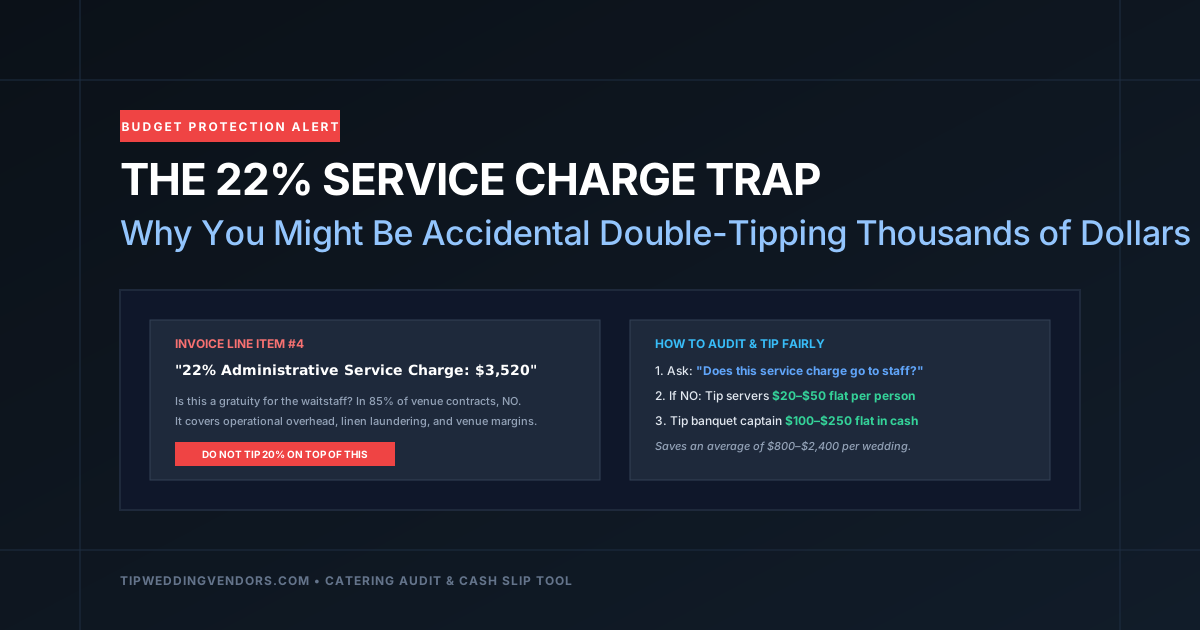
On an average $15,000 food and beverage invoice, a 22% "Service Charge" adds $3,300 to your contract. Many couples assume this line item serves as the tip for banquet servers and bartenders. Others believe it is purely overhead and tip an additional 20% on top—accidentally spending an extra $3,000. Here is how to decode your catering invoice.
1. Service Charge vs. Gratuity: The Legal Distinction
Under labor laws in most jurisdictions, a "Gratuity" or "Tip" legally belongs entirely to the hourly waitstaff and bartenders. In contrast, an "Administrative Fee" or "Service Charge" belongs to the banquet venue or catering company to cover insurance, linen laundering, and general overhead, with zero dollars required to reach servers.
2. The 3-Sentence Email to Send Your Caterer Today
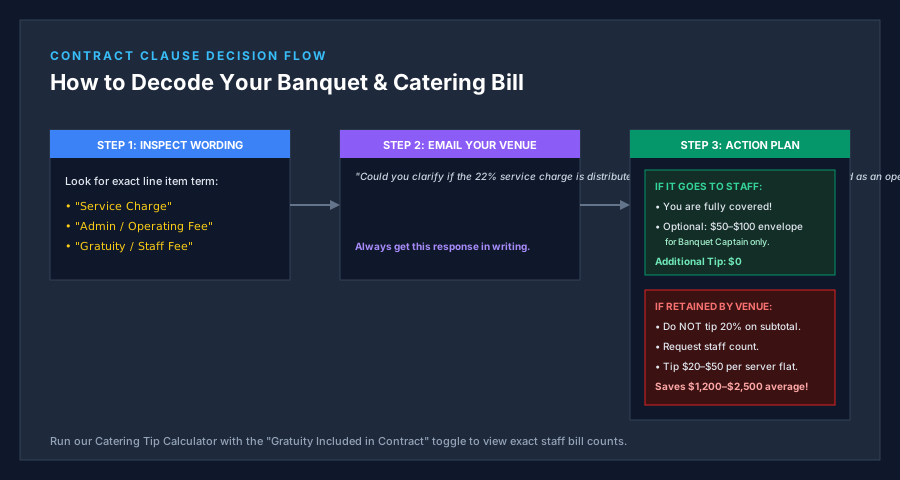
To audit your invoice without awkwardness, send this exact email to your banquet manager 30 days before the wedding: "Hi [Name], we are preparing our staff appreciation envelopes for wedding day. Could you clarify whether the 22% service charge on our contract is distributed directly to banquet servers as gratuity, or retained as an operating charge? Also, could you provide the total headcount of servers and bartenders assigned to our event?"
3. How to Tip Fairly If the Charge is Retained by the Venue
If the venue confirms the service charge is operational overhead, do NOT tip an extra 20% on your total $15,000 invoice. Instead, tip the staff directly using flat cash envelopes: prepare $20 to $50 per server and bartender, and $100 to $250 for the banquet captain. This rewards the hardworking crew directly while saving you $1,500 to $2,500.
Key Takeaway & Bank Prep Strategy
Use our Catering Service Charge Calculator toggle to automatically calculate flat-rate staff envelopes and generate the exact bank bills needed.
Calculate Your Exact Cash Envelopes
Input your booked vendors into our calculator to get an exact $100, $50, $20, and $10 bill requisition slip for your bank teller.